Why Lighting Matters Differently in Municipal and Government Buildings
For city halls, county offices, public works facilities, courthouses, and municipal service buildings, lighting is rarely anyone's top priority — and that's exactly why it tends to become a significant, unmanaged cost.
Unlike private commercial buildings where a single decision-maker can move quickly, municipal facilities operate under budget cycles, procurement requirements, and public accountability standards that make large capital projects difficult to advance. Lighting upgrades get deferred year after year, old fixtures keep running long past their useful life, and the ongoing costs — energy bills, maintenance labor, emergency replacements — quietly compound in the background.
What changes the picture is when an upgrade can be structured in a way that fits how municipal governments actually operate: low upfront cost, clear ROI documentation, utility rebates handled externally, and minimal disruption to building operations.
That's exactly the scenario LED retrofits are built for.
The Specific Challenges Municipal Buildings Face with Lighting
Municipal facilities have a few characteristics that make outdated lighting particularly costly:
Long operating hours. City halls, public safety facilities, courthouses, and service buildings often run extended hours — sometimes around the clock. Every hour of operation with an inefficient fixture is money that could be redirected to other budget priorities.
Large, varied footprints. A single municipal campus might include office space, public lobbies, meeting rooms, storage areas, parking lots, and exterior pathways. Each area has different lighting requirements and different fixture types, and managing maintenance across all of them strains already-lean facilities teams.
Deferred maintenance cycles. Budget constraints mean fixtures often run well past their expected lifespan. Older T12 fluorescent systems, metal halide fixtures, and high-pressure sodium parking lot lights are common in municipal buildings that haven't been updated in 10 or more years. These systems are increasingly expensive to maintain as parts become harder to source.
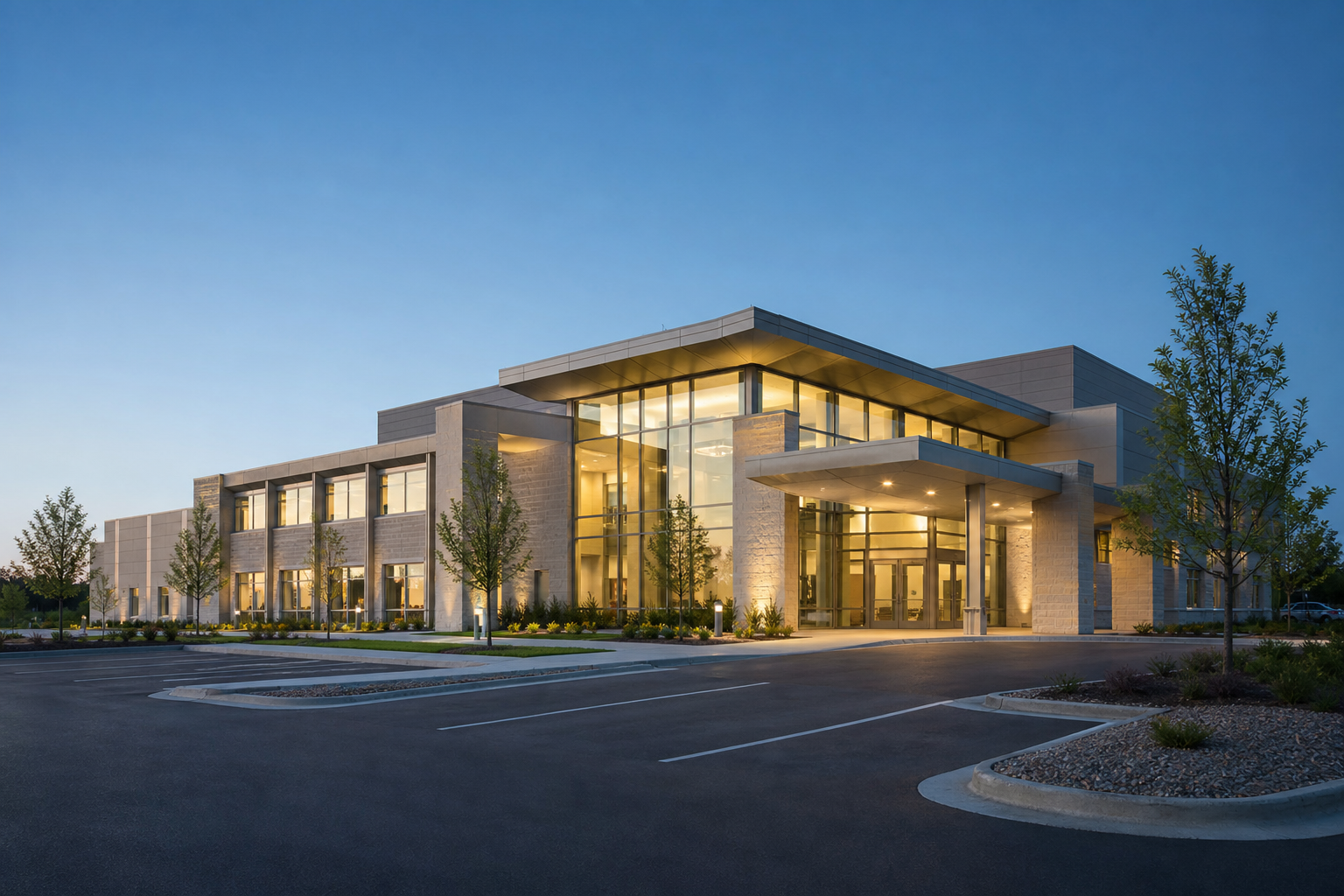
Public-facing spaces. Lobbies, public counters, hearing rooms, and exterior entrances shape how residents perceive their local government. Outdated, flickering, or poorly lit spaces affect both the public experience and employee morale.
Accountability for spending. Every capital expenditure in a municipal building requires justification. The good news: LED retrofits produce clear, documented savings data — energy reduction in kWh, projected monthly savings, utility rebate amounts, and payback timeline — that translates directly into the kind of ROI documentation municipal administrators and elected officials need to approve and defend a project.
What LED Lighting Actually Changes in Municipal Facilities
Reduced Energy and Utility Costs
This is the core financial driver. Modern LED fixtures use significantly less wattage than the fluorescent, metal halide, and HID systems they replace — typically 40–60% less energy for comparable light output. For a facility running extended hours, that reduction translates to meaningful, recurring monthly savings on utility bills.
For municipal facilities served by Georgia Power or Dominion Energy South Carolina, those savings are further accelerated by utility rebate programs that offset a significant portion of the project cost at the outset — before the energy savings even begin.
Dramatically Lower Maintenance Burden
LED fixtures carry rated lifespans of 50,000 to 100,000 hours, compared to 8,000–15,000 hours for fluorescent tubes and 15,000–20,000 hours for metal halide fixtures. For a facilities team managing a large campus, the practical impact is that routine bulb and ballast replacements — which require staff time, equipment, and materials — become rare rather than routine.
Exterior parking lot fixtures and wall packs, which often require lift equipment for access, see some of the greatest maintenance cost reductions after an LED upgrade.
Improved Light Quality in Public Spaces
LED fixtures deliver more consistent, higher-quality light than older technologies. In public lobbies and service counters, better lighting improves the experience for residents and makes it easier for staff to read documents and work accurately. In public safety applications — parking areas, exterior pathways, stairwells — better light quality directly supports safety.
Older fluorescent systems are also prone to flickering, color inconsistency, and delayed warm-up times in cold conditions. LED fixtures eliminate all of these issues.
Better Visibility in Outdoor and Parking Areas
Parking lots, vehicle access areas, exterior pathways, and building perimeters are critical safety zones in any public building. Older high-pressure sodium and metal halide fixtures produce yellowish, uneven light that creates shadows and reduces visibility. LED area lights and wall packs produce brighter, more uniform, white-spectrum light that improves visibility for both the public and security personnel — while using significantly less energy than the fixtures they replace.
Documentation That Supports Budget Approvals
One of the practical advantages of LED projects for municipal administrators is that the financial case is straightforward to document. A qualified lighting contractor can produce a pre-project savings analysis that shows projected kWh reduction, estimated monthly bill savings, applicable utility rebate amounts, total project cost, and estimated payback period — all the information needed to build a capital budget request or present to a governing board.
Utility Rebates: How They Reduce Upfront Cost
Municipal and government buildings in Georgia and South Carolina can access utility rebate programs that significantly reduce the net cost of LED lighting projects.
Georgia Power offers commercial lighting incentives for eligible buildings through its rebate programs, covering a substantial portion of project costs on a per-fixture basis. Georgia Power's SBES (Small Business Energy Savings) program can cover up to 70% of eligible project costs for qualifying smaller facilities, and the Commercial Energy Efficiency Program provides rebates for larger municipal applications. Both programs cover the full range of commercial lighting upgrades — interior fixtures, exterior area lights, wall packs, and lighting controls.
Dominion Energy South Carolina offers commercial and institutional lighting rebates for eligible facilities in its service area, covering up to 50% of project costs through its standard commercial incentive program. Limited-time Fast Track Bonus incentives are currently available, offering up to 40% more in incentives for projects completed by August 15, 2026.
In both programs, DTL manages the rebate process from start to finish — pre-approval applications, post-installation documentation, and follow-up — so your facilities team doesn't carry the administrative burden.
What the Process Looks Like
A municipal LED lighting project through DTL follows a straightforward process designed to minimize disruption to building operations:
1. Free Assessment We evaluate your current lighting across the facility — fixture types, wattage, operating hours, maintenance history — and identify the best opportunities for energy and cost reduction.
2. Savings and Rebate Analysis We produce a clear financial summary: projected energy reduction, estimated monthly savings, applicable utility rebates, total project investment, and payback timeline. This documentation is designed to support internal budget approval processes.
3. Scheduling Around Operations Installation is scheduled around your facility's operating hours — after hours, weekends, or phased by building section — so there's no disruption to public services or daily operations.
4. Rebate Administration We manage all utility rebate paperwork, pre-approval, and post-installation verification. The rebate offsets your upfront project cost before you pay the net balance.
5. Project Closeout and Documentation You receive complete project documentation — fixture records, photometric data, warranty information, and rebate confirmation — for your facilities records.
Common Questions from Municipal Facility Managers
Can LED projects be phased across fiscal years? Yes. Projects can be scoped and phased by building section, floor, or fixture type to align with annual budget cycles. We can structure an assessment to identify the highest-priority upgrades for immediate action and plan subsequent phases for future budget years.
Do utility rebates go to the building or the contractor? In most programs, rebates are structured to reduce the net project cost. We manage the rebate application and confirmation; the rebate offsets the cost of the project directly. Your team receives documentation showing the rebate amount and the net cost.
How long does installation typically take? Most single-building municipal projects are completed within a few days to a week, depending on square footage and fixture count. Larger campus projects are phased to avoid operational disruption.
Are there procurement requirements we need to follow? This varies by municipality. We're experienced working within formal procurement frameworks and can provide documentation, specifications, and references to support your process. Contact us to discuss your specific requirements.
What warranty do LED fixtures carry? Commercial-grade LED fixtures typically carry 5–10 year manufacturer warranties. We document all fixture warranty information at project closeout.
Is Your Municipal Facility a Candidate for an LED Upgrade?
If your building checks any of these boxes, it's worth a conversation:
- Fluorescent T8, T12, or older high-pressure sodium fixtures still in use
- Fixtures or ballasts requiring frequent replacement
- Parking lot or exterior lighting more than 8–10 years old
- Energy costs that haven't been reviewed or benchmarked recently
- Maintenance budget being consumed by lighting-related labor and materials
- A facilities improvement initiative or capital plan where ROI documentation matters
A free assessment gives you the complete financial picture with no obligation — projected savings, applicable rebate amounts, and a realistic cost and payback estimate your team can work with.
Schedule a Free Assessment → Check Your Facility's Rebate Eligibility → Learn More About Our Municipal Lighting Work →