 Georgia Power SBES Lighting Rebates for Small Businesses">
How Georgia Power’s SBES lighting rebates work
Georgia Power’s Small Business Energy Savings (SBES) program can cover up to 70% of the cost of upgrading your facility to LED lighting.
In most cases, that means businesses only pay ~30% of the total project cost, with incentives applied directly to the invoice — not months later.
For example, a $30,000 lighting upgrade could cost your business closer to $9,000 out of pocket.
Want to See if Your Property Qualifies?
Want to see if your property qualifies? Check your eligibility here and we'll confirm with Georgia Power within 24–48 hours.
At a high level, the SBES process is designed to be straightforward. You submit your business and facility details, Georgia Power’s program partner (ICF) confirms whether the account qualifies, and a no-cost on-site assessment is scheduled. The assessment identifies specific lighting fixtures and controls that can be upgraded while meeting program rules.
Once the scope is defined, the program calculates incentives based on eligible equipment and estimated energy savings. In many cases, Georgia Power covers roughly 70% of qualified costs, while the customer pays the remaining portion, plus taxes and any lift-related charges. For a $30,000 lighting project, that can mean an incentive of about $21,000, leaving approximately $9,000 on the customer side.
Importantly, SBES incentives are applied as instant rebates at the project level rather than mailed months later. This structure reduces the need for large upfront capital and makes it easier for finance teams to approve projects. Full program details are provided on Georgia Power’s site at Georgia Power SBES.
Eligibility criteria for SBES lighting upgrades
Eligibility focuses on making sure incentives reach true small business accounts with meaningful energy-saving potential. To qualify, facilities must typically have a 12‑month peak demand of 249 kW or less and be served on a Georgia Power commercial tariff at the site where the upgrades will be installed.
On the equipment side, SBES emphasizes verifiable savings. Lighting must achieve at least a 10% reduction in wattage compared with the existing fixtures, and upgraded equipment needs to operate at least 1,000 hours per year. This ensures that incentives are directed toward projects that will generate real and measurable reductions in energy use.
Because the program can fund up to $50,000 per building per year, multi-building portfolios may be able to phase upgrades site by site. For example, a regional operator with three qualifying locations could potentially complete projects at each facility over multiple years while staying within annual caps.
If you already work with a trusted contractor, that firm can apply to join the SBES Participating Contractor network through Georgia Power’s "Work with Us" portal. This allows the program team to verify credentials and confirm that designs, products, and installation practices align with SBES requirements.
What to expect during the facility lighting assessment
The SBES experience begins with a no-cost assessment conducted by a program-trained assessor or participating contractor. The goal is to document existing lighting conditions, identify upgrade opportunities, and create a clear, data-supported pathway to savings.
During the walkthrough, the assessor will record fixture locations, types, wattages, mounting heights, and operating hours by area. Spaces such as offices, warehouses, production zones, and exterior areas are typically evaluated separately so energy savings can be estimated accurately. For example, a 100,000‑square‑foot warehouse may have very different operating hours from adjacent office areas.
The assessor also evaluates qualitative factors such as illumination levels, color quality, and uniformity. This ensures that recommended LED solutions do not simply reduce wattage, but also maintain or improve visibility and safety for staff and visitors. In parking or loading areas, higher-quality light can support clearer camera footage and better perimeter awareness.
Following the visit, you receive a written report outlining proposed fixture replacements or retrofits, estimated energy and maintenance savings, and projected incentive amounts. This report forms the basis of the detailed project proposal and provides objective data that facility and finance stakeholders can review.
Building a project proposal: costs, incentives, and payback
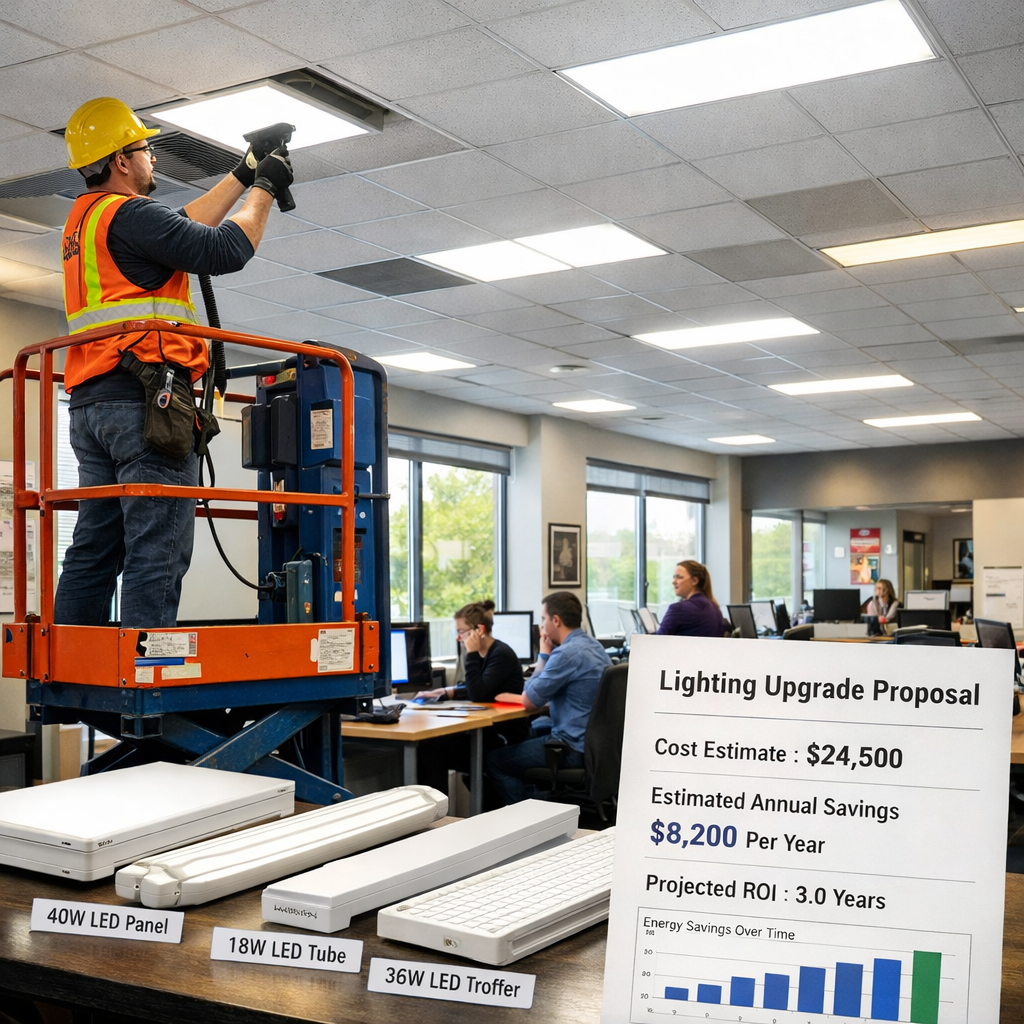
Once the assessment is complete, the next step is a project proposal that aligns technical recommendations with clear financial metrics. The proposal should itemize fixture counts, unit costs, labor, controls, and any lift or access expenses. SBES-eligible items and non-eligible scope should be clearly separated.
Program incentives are then calculated according to SBES rules and applied against the eligible portion of the project. For lighting, this often results in Georgia Power funding about 70% of qualified costs. For instance, if eligible lighting scope totals $40,000, the incentive may cover roughly $28,000, leaving a customer contribution of about $12,000 plus taxes and lift fees.
The proposal should also include an energy savings model that converts kilowatt-hour reductions into estimated monthly bill savings. A typical small or mid-sized facility that replaces aging fluorescent or HID fixtures with LEDs can often reduce lighting-related energy use by 40–70%, depending on operating hours and baseline efficiency.
With incentives and bill savings combined, simple payback periods commonly fall in the two- to four-year range. In some cases, organizations align projects with capital planning cycles or sustainability targets, using the SBES incentive to accelerate upgrades that were already under consideration.
Implementation: scheduling, installation, and minimizing disruption
After approval, project execution needs to respect ongoing operations. A well-structured SBES lighting project is phased to match shift patterns, tenant occupancy, or production windows so that business activities can continue without unnecessary interruption.
Contractors may schedule work during evenings, weekends, or low-traffic periods to complete fixture swaps in critical areas. In office environments, for example, upgrades may be performed after-hours to avoid impacting meetings and daily work. For warehouses or manufacturing, carefully sequenced work zones can keep material handling routes open and safe.
The project team also coordinates with Georgia Power’s program administrators to ensure that any required pre- and post-installation documentation is captured accurately. This may include fixture counts, product cut sheets, updated wattage tables, and photographic verification. Accurate documentation supports a smooth incentive approval process and reduces the risk of funding delays.
For facilities that require lift equipment, contractors plan routes, staging areas, and safety measures in advance. Clear communication with facility staff about noise, temporary access restrictions, and lighting outages helps maintain a safe environment throughout construction.
Long-term benefits of SBES-funded LED lighting upgrades
The financial impact of SBES goes beyond the one-time rebate. Over the life of the equipment, efficient LED lighting can reduce utility costs, maintenance expenses, and operational risk, while supporting broader sustainability objectives.
Modern LED systems typically offer lifetimes of 50,000 hours or more, which reduces the frequency of lamp changes and associated labor or lift rentals. For facilities with high ceilings or difficult access, fewer service calls translate directly into budget relief and lower safety exposure for maintenance teams.
Improved light quality can also support better visibility in work areas, loading docks, corridors, and exterior spaces. Consistent, high-CRI illumination helps staff perform detailed tasks and can enhance the perception of safety for occupants and visitors. For organizations focused on brand experience, upgraded lighting can create cleaner, more welcoming spaces.
Finally, documented energy savings from SBES projects can contribute to corporate environmental reporting. Reduced electricity consumption lowers associated greenhouse gas emissions, helping organizations progress toward internal sustainability goals or public commitments. By combining strong incentives, measurable savings, and an organized delivery process, Georgia Power’s SBES program gives small businesses a practical path to modern, efficient lighting.
Frequently Asked Questions
How long does it take to confirm eligibility?
Typically 24–48 hours after submission.
Do I need to pay upfront?
In most cases, no large upfront payment is required since incentives are applied directly to the project.
Can I use my own contractor?
Yes, but they must be approved through Georgia Power’s SBES program.
What types of businesses qualify?
Small-to-mid sized commercial facilities typically qualify. Large national chains and high-energy-use properties may not.